Research Overview
My research sits at the intersection of $\color{#00a0d1}{\text{statistical theory,}}$ $\color{#00a0d1}{\text{probabilistic computation,}}$ and $\color{#00a0d1}{\text{scientific inference}}$. I enjoy developing principled frameworks for reasoning under uncertainty in complex, high-dimensional systems.
Specifically, my research spans the topics of uncertainty quantification, surrogate modeling, computer model calibration, statistical learning, Bayesian optimization and generative modeling, with applications in computer experiments, engineering sciences, and mission-critical physical systems.
Bayesian inverse problems
$\color{#00a0d1}{\text{Inverse problems ask:}}$ given observations $y = \mathcal{G}(u) + \varepsilon$, can we recover the unknown field or parameter $u$? The forward operator $\mathcal{G}$ is typically a differential equation or physical model, making direct inversion ill-posed in the Hadamard sense.
The Bayesian formulation regularises this naturally: by placing a prior $\pi_0(u)$ over the unknown and conditioning on data, the posterior
\[\pi(u \mid y) \propto \mathcal{L}(y \mid u)\, \pi_0(u)\]encodes full uncertainty over plausible reconstructions. My work focuses on developping scalable computational methods for characterising this posterior and frequentist approaches to this problem with uncertainty guarantees.
Topics: Computer Model Calibration · Tikhonov–Bayes connections · pCN algorithms · posterior consistency
Uncertainty quantification
Complex computational models, from climate simulators to structural solvers, propagate uncertainty in a way that is rarely tractable analytically. $\color{#00a0d1}{\text{UQ provides the mathematical}}$ $\color{#00a0d1}{\text{toolkit}}$ to characterise how $\color{#00a0d1}{\text{input uncertainty p(x)}} $ maps to $\color{#00a0d1}{\text{output variability p(y)}},$ through a black-box or grey-box model $y = f(x)$.
My research addresses both:
- $\color{#00a0d1}{\text{Forward propagation:}}$ using surrogate modelling (typically GPs but trying to learn more about polynomial chaos expansions and neural networks nowadays) to push distributions through expensive simulators.
- $\color{#00a0d1}{\text{Sensitivity analysis:}}$ — via Sobol’ indices and variance decompositions to identify which inputs drive output uncertainty, formally expressed as \(S_i = \frac{\mathbb{V}[\mathbb{E}[Y \mid X_i]]}{\mathbb{V}[Y]}\)
I am particularly interested in settings where $f$ is expensive to evaluate, coupling emulator construction with rigorous statistical estimation of uncertainty measures and their confidence intervals.
Topics: Gaussian Process (and their variants) emulation · Sobol’ indices · error propagation · conformal prediction
Bayesian Optimization & Optimization under uncertainty
When the objective $f: \mathcal{X} \to \mathbb{R}$ is expensive, noisy, or unknown, classical optimisation methods are inapplicable. $\color{#00a0d1}{\text{Bayesian optimisation (BO) maintains a probabilistic}}$ $\color{#00a0d1}{\text{surrogate and sequentially evalautes points that maximise an acquisition }}$ $\color{#00a0d1}{\text{ function balancing exploration and exploitation,}}$ such as expected improvement
\[\mathrm{EI}(x) = \mathbb{E}\!\left[\max(f(x) - f^*, 0)\right].\]Beyond standard BO, I am interested in optimisation under uncertainty, where the objective itself involves an expectation over stochastic inputs:
\[\min_{x \in \mathcal{X}}\; \mathbb{E}_{\xi}\!\left[F(x, \xi)\right]\]requiring joint surrogate models over both inputs variables and “hyperparameters”. Applications span experiment design, hyperparameter tuning, and robust engineering design.
Topics: Sequential design · acquisition functions · Thompson sampling · batch BO ·
Active learning (AL)
$\color{#00a0d1}{\text{Active learning addresses the data-efficiency problem:}}$ given a budget of $N$ labelled observations, which input location $x_1, \ldots, x_N \in \mathcal{X}$ should be selected to maximise learning? The Bayesian framing connects directly to optimal experimental design, choosing experiments to maximise expected information gain
\[\mathbb{E}\!\left[D_{\mathrm{KL}}\!\left(\pi(\theta \mid y)\;\|\;\pi(\theta)\right)\right].\]I aim to develop AL strategies for scientific and engineering applications where evaluations are costly, including batch-sequential designs and possibly online settings. A recurring theme is the interplay between the surrogate model’s epistemic uncertainty and the practical cost associated with new input location , particularly in settings with structured input spaces or physics-based constraints. 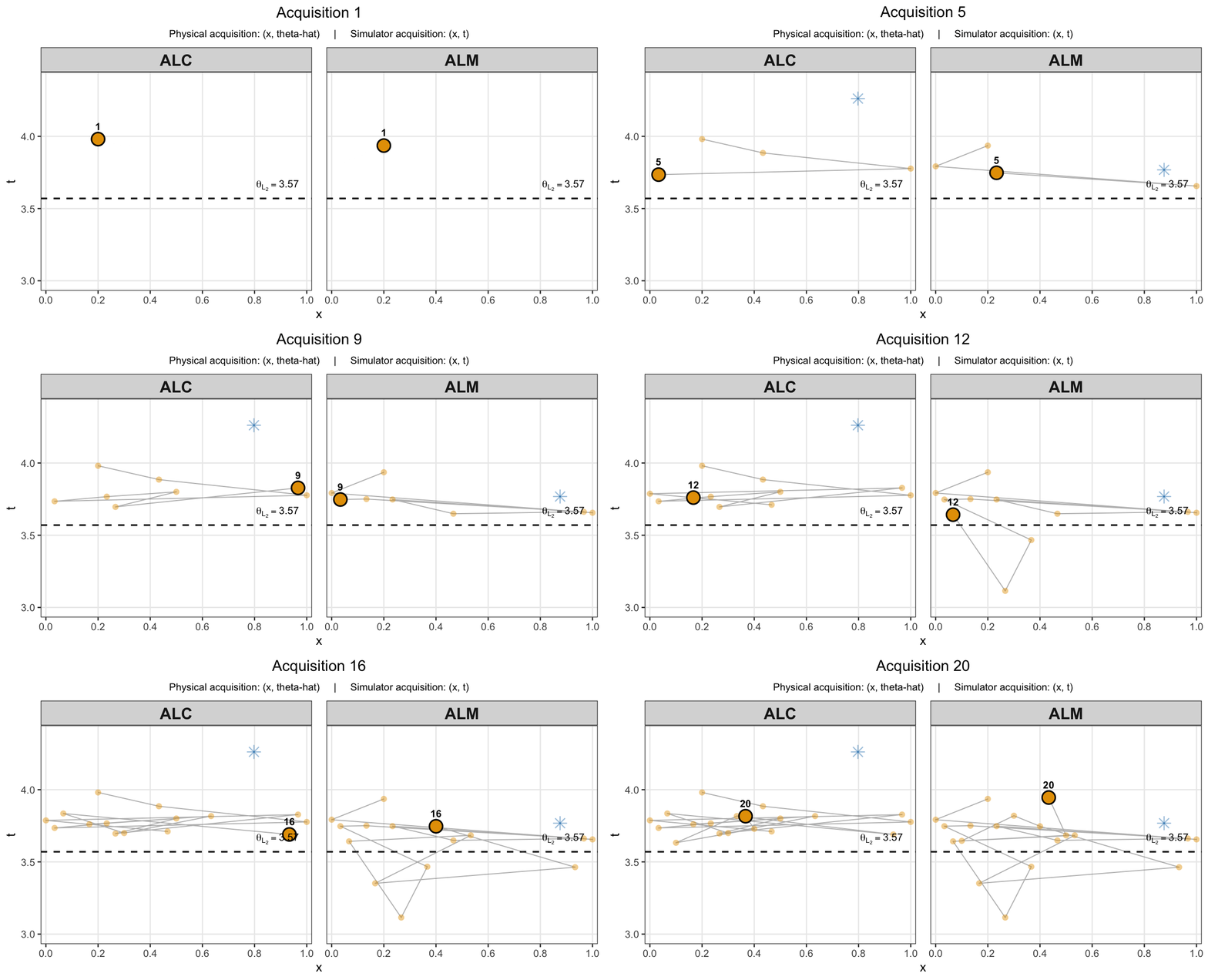
Topics: optimal experimental design · information gain · acquisition functions · surrogates · ALM/ALC/ALD
Monte carlo inference
Posterior distributions $\pi(\theta \mid y) \propto \pi(y \mid \theta)\,\pi(\theta)$ rarely admit a closed form, and the normalising constant is intractable in high-dimensions (typically $d > 5$). $\color{#00a0d1}{\text{Monte Carlo inference replaces this integral}}$ $\color{#00a0d1}{\text{with an empirical average over samples}}$ drawn from the posterior, so that for $\theta^{(1)}, \ldots, \theta^{(N)} \sim \pi(\theta \mid y)$,
\[\mathbb{E}[g(\theta) \mid y] \approx \frac{1}{N}\sum_{i=1}^N g(\theta^{(i)}),\]with error decaying at the canonical $O(N^{-1/2})$ rate, independent of the dimension of $\theta$.
My work draws on:
- $\color{#00a0d1}{\text{MCMC:}}$ Metropolis–Hastings, Gibbs, and Hamiltonian Monte Carlo, constructing a Markov chain whose stationary distribution is the target posterior.
- $\color{#00a0d1}{\text{Importance sampling & SMC:}}$ reweighting samples from a tractable proposal $q(\theta)$ via $w(\theta) = \pi(\theta \mid y)/q(\theta)$ when direct sampling is infeasible.
I am particularly interested in surrogate-assisted sampling, where an expensive forward model embedded in the likelihood (for example, a PDE solver is replaced by a Gaussian process emulator), making chains feasible at scale while propagating emulator uncertainty back into the posterior.
Topics: MCMC (Metropolis-Hastings, HMC) · importance sampling · sequential Monte Carlo · surrogate-assisted inference · convergence diagnostics
$\color{#00a0d1}{\text{These areas are deeply interconnected!}}$ Monte Carlo inference underpins Bayesian inverse problems; active learning drives data collection for UQ; Bayesian optimisation uses the same GP machinery as uncertainty propagation.